
Don’t mind the gap

Michel Degosciu is managing partner of LPX AG
Understanding risk and how it balances against returns is the starting point for almost any investment decision. Benchmark indices are vital to investors because they provide the information needed to assess how an asset class performs as well as how individual companies stack up against their peers and rivals. At LPX, we produce two kinds of index. One tracks share prices, just like the CAC 40 or the FTSE 100. The other tracks net asset values (NAV) – the value of the companies held in listed private capital portfolios. The difference between the two gives rise to the discount.
Because it can be benchmarked and indexed, listed private capital provides a valuable service for the wider industry. Institutional investors are increasingly using the LPX indices to help them manage risk in their own (unlisted) private equity holdings. They are especially interested in the NAV indices we produce because these are not subject to the vagaries of market sentiment that push share prices up and down, but instead represent an up-to-date proxy for underlying asset valuations across the private capital industry. Indeed, we use all publicly available information about portfolios to track NAV, for example when an asset is sold, rather than just relying on the periodic publication of NAV by a private equity company at results time. By understanding the performance and volatility of NAV, investors can more reliably form a view on how much capital to allocate to private assets as a share of their total assets under management.
Those who recognise that private equity assets are not as risky as some imagine have found themselves at a real advantage during previous episodes of significantly widening discounts.
When discounts widen as much as they have in recent months, many simply expect NAVs to come down to narrow the gap. There is some truth to this, but it is often exaggerated. For the most part, companies in private equity portfolios are cash generative today making their values less sensitive to changing market conditions. As an industry we must constantly counter this misperception because it is a key contributor to widening discounts at times of market stress. Those who recognise that private equity assets are not as risky as some imagine have found themselves at a real advantage during previous episodes of significantly widening discounts.
It is likely that NAVs will come down a little to reflect higher market interest rates and lower multiples, so this will contribute to a narrowing of discounts in the months ahead. But should this worry investors? Will a 35% discount today simply be eaten up by lower asset values or does it represent a buying opportunity. History suggests the latter.
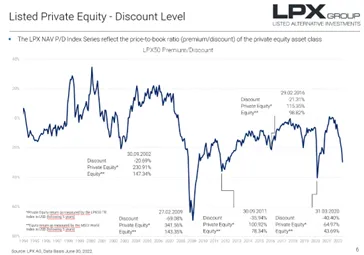
We have looked at listed private capital performance since 1993. Stocks have ended the year trading at a discount to NAV in 19 out of those 28 years. And following 15 of those 19 discount years, they have significantly outperformed traditional equity markets. For example, in December 2002, the discount on our LPX50 index of private equity companies was 20.7%. Over the next five years, the index returned 231% compared to 147% for the MSCI World. The same pattern is repeated again and again – in 2009, in 2011, 2016 and 2020, for example. Each time, NAV did tend to be reduced initially to reflect weaker market conditions, but recovering share prices usually made a more significant contribution to narrowing the discount, and outperformance ensued in the years to follow as NAVs returned to growth.
For those with a long-term view and the courage to weather short-term volatility, there is no reason to mind the gap.
And so we find ourselves looking at similar market conditions again today. Listed private equity can offer access to private assets at exceptionally low prices at moments like this. I do not have a crystal ball, but the evidence is pretty strong that the current crunch will represent a buying opportunity for investors prepared to look beyond the current uncertainty. For those with a long-term view and the courage to weather short-term volatility, there is no reason to mind the gap.